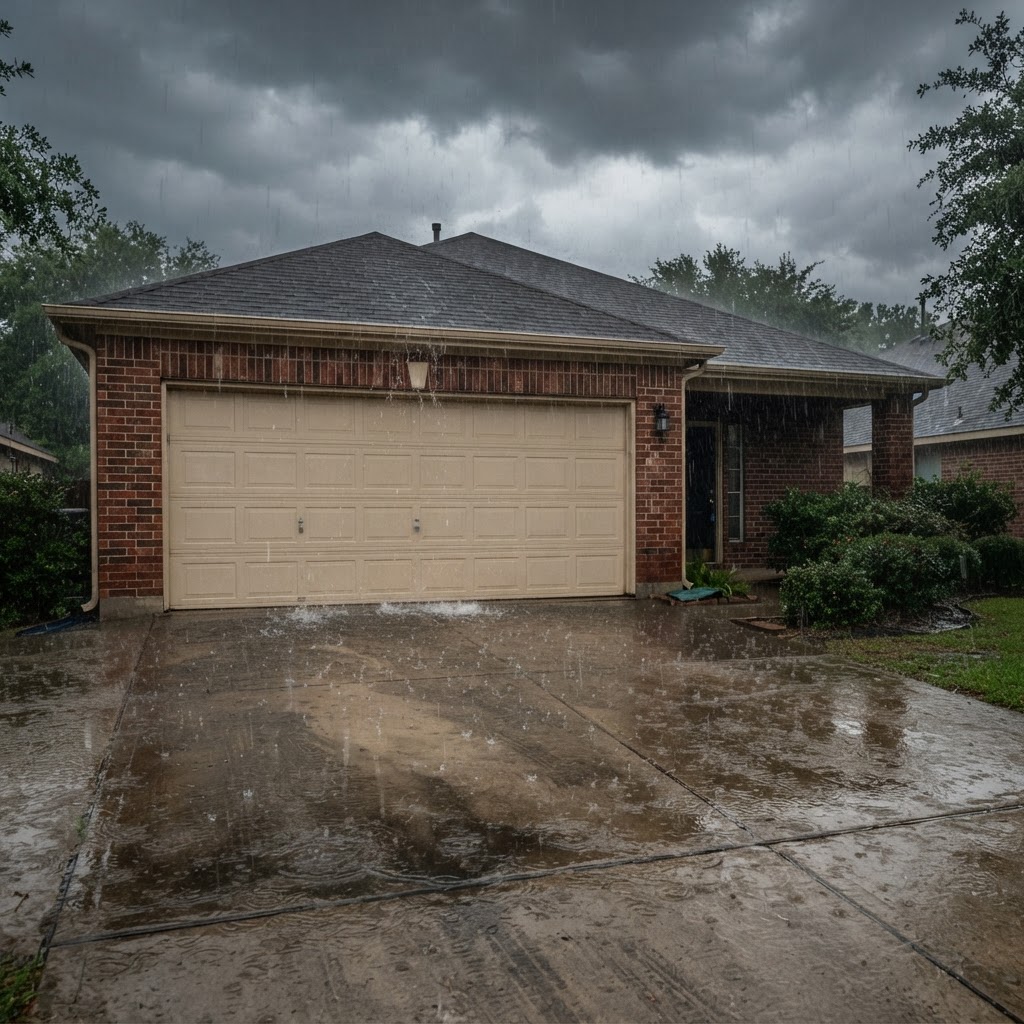
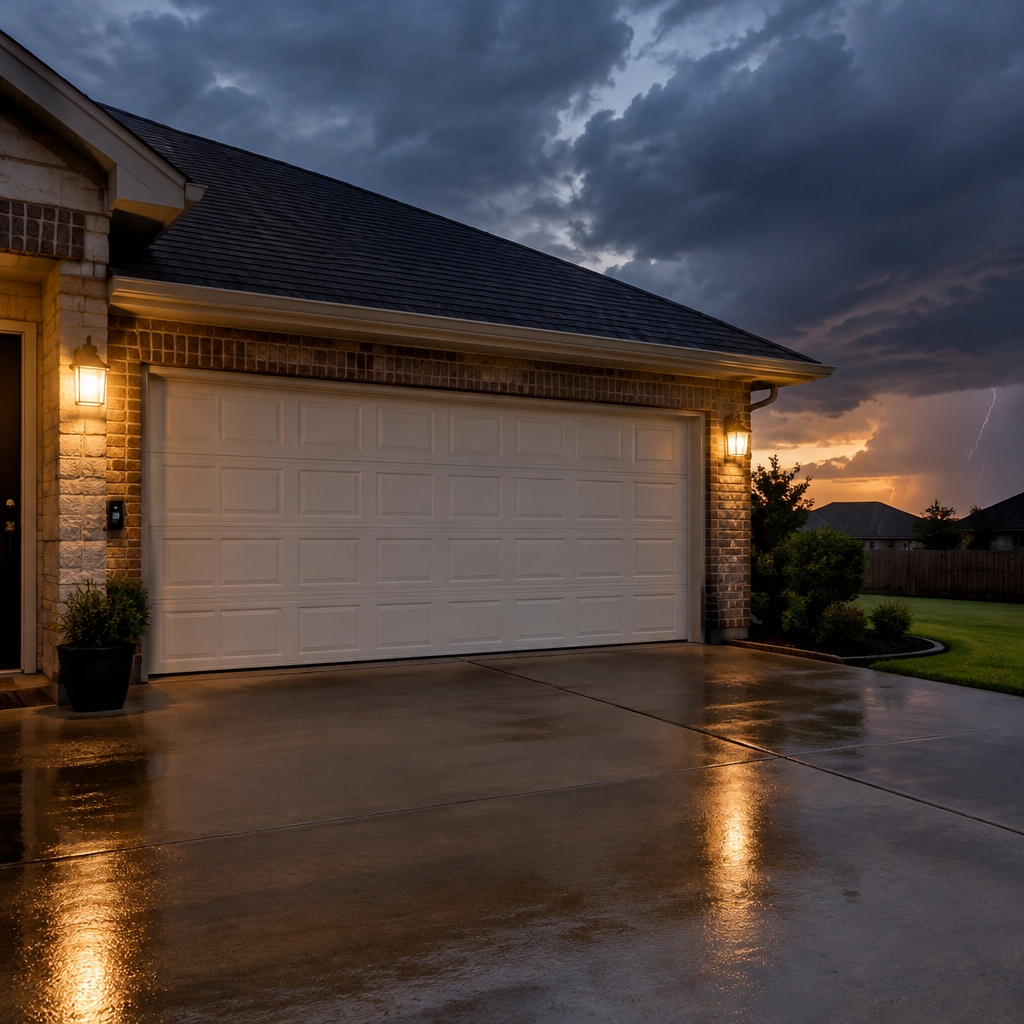
Texas thunderstorms fry garage door openers every year, and DFW's grid makes it worse. Here's how to spot surge damage, protect your opener, and know when to call a pro.
You come home after a storm, press the remote, and nothing happens. The opener's light is out, the door won't budge, and there's no obvious damage anywhere. In Rockwall and across the DFW metroplex, this scene plays out after nearly every major thunderstorm season. The culprit is often a power surge, and garage door openers are uniquely vulnerable to it.
A surge is a brief spike in voltage that travels through your home's wiring. It can enter through the garage circuit, the opener's low-voltage control wires, or even the coax and phone lines many openers share a wall with. Because openers combine a sensitive circuit board with a motor that draws heavy current, they sit right in the path of that damage. This guide covers how to recognize surge damage, how to prevent it, and when it's time to call a professional.
How a Power Surge Damages Your Garage Door Opener
Most modern openers run on a logic board that manages travel limits, safety sensors, force settings, and radio reception. That board operates on low voltage, which means it has almost no tolerance for a spike. When a surge hits, it typically destroys one of three things:
- The logic board — the door stops responding, lights blink erratically, or the unit is completely dead.
- The transformer — the opener may hum or click but never move the door.
- The radio receiver — the door works from the wall button but ignores every remote and keypad.
Not all surge damage is instant. A series of smaller surges, common in neighborhoods with overhead lines and frequent switching, can degrade a board over months until it fails for no apparent reason. If your opener is five years old or more and dies suddenly after a storm season, cumulative surge damage is a strong suspect.
Signs Your Opener Took a Surge Hit
Before you assume the motor is gone, look for these telltale signs:
- The opener is completely dead, but the breaker and GFCI outlet are fine.
- The wall control works while remotes and the keypad do not.
- The door moves a few inches and stops, or reverses immediately.
- The light comes on but the motor never engages.
- You smell a faint burnt odor near the opener housing.
- Error codes appear that didn't exist before the storm.
If you're seeing blinking patterns and aren't sure what they mean, our guide to decoding opener error codes walks through the most common sequences for the major brands.
Why DFW Storms Are Especially Hard on Garage Doors
North Texas averages more than 40 thunderstorm days a year, and Rockwall sits in one of the more active corridors east of Dallas. Two things make the risk worse here. First, lightning-induced surges can travel miles along power lines before reaching your panel. Second, the grid itself creates surges when power is restored after an outage. That moment when the lights come back on is actually one of the most dangerous for electronics, because voltage can return unevenly and in spikes.
Homes built in the fast-growing corridors around Fate, Royse City, and Forney often share transformers with active construction, which adds another source of switching surges. Older homes in established Rockwall neighborhoods deal with aging wiring and grounding that may no longer meet code.
How to Protect Your Garage Door Opener
1. Install whole-home surge protection
A surge protective device (SPD) at the main panel is the single most effective defense. It costs far less than a replacement logic board and clamps surges before they spread through the house. Have a licensed electrician install one that's rated for your panel and includes an indicator light so you know when it needs replacing.
2. Add point-of-use protection at the opener
A quality surge strip or receptacle adapter at the opener's outlet catches what the panel device lets through. Look for a joule rating above 1,000 and a connected-equipment warranty. Avoid cheap power strips, which offer little real protection.
3. Unplug before storms and outages
If a serious storm is forecast, unplug the opener at the ceiling outlet. When power returns after an outage, wait a few minutes before plugging it back in so the grid can stabilize.
4. Keep a battery backup in the loop
A battery backup unit doesn't just keep the door working during an outage, it also isolates the opener from grid irregularities while running on battery. Our breakdown of battery backup options for Texas power outages explains which systems handle this best.
5. Verify your grounding
Surge protection only works as well as your home's grounding electrode. If your garage outlets are ungrounded or you have a bootleg ground from an older remodel, protection devices have nowhere to send the excess current. An electrician can check this in under an hour.
What to Do If Your Opener Is Already Damaged
- Turn off the breaker to the opener circuit before inspecting anything.
- Check the obvious first — outlet power, GFCI reset, and the wall control. Sometimes a tripped GFCI mimics a dead opener.
- Look for physical evidence — scorching, a burnt smell, or a visibly damaged board inside the housing.
- Don't replace the board blindly. If the surge came through the door's control wiring, a new board can fail the same way unless the underlying issue is addressed.
- Call a professional for diagnosis if the opener is dead but power is present. Our six-step opener troubleshooting guide covers what you can safely check yourself first.
Repair or Replace After a Surge?
If your opener is under eight years old and only the board or receiver failed, a board replacement is usually the economical choice. If the unit is older, has already had one board replaced, or the motor itself shows heat damage, replacement often makes more sense. Modern openers include better onboard surge suppression, and a new unit with a battery backup and Wi-Fi control solves several problems at once.
One more thing worth checking after any major storm: the door itself. Hail and wind can dent panels, bend tracks, and knock the door out of alignment even when the opener survives. Our guide to protecting your garage door from hail and storm damage covers what to inspect and what your insurance may cover.
Bottom Line
Power surges are one of the most common causes of garage door opener failure in North Texas, and they're almost entirely preventable. Whole-home surge protection, a quality strip at the opener, and sensible habits around outages will save you hundreds in board replacements. If your opener is already dead, get it diagnosed before spending money on parts, and make sure the fix addresses how the surge got in.
Servicing Rockwall, Heath, Fate, Royse City, Rowlett, Terrell, Forney, Mesquite, Garland and the greater Dallas–Fort Worth area.
Need Garage Door Service in Rockwall, TX & DFW Metroplex?
Same-day repair, fair pricing, and 24/7 emergency dispatch. Call the experts at Adams Superior.